Book Review | Entrepreneurship, Investing and the Value of Contrarian Thinking
I first read Zero to One by Peter Thiel approximately ten years ago, and it remains one of the books that has left a lasting impression on me. Looking back, I can see how it helped put me on a path towards a very different way of thinking about business, innovation and investing.
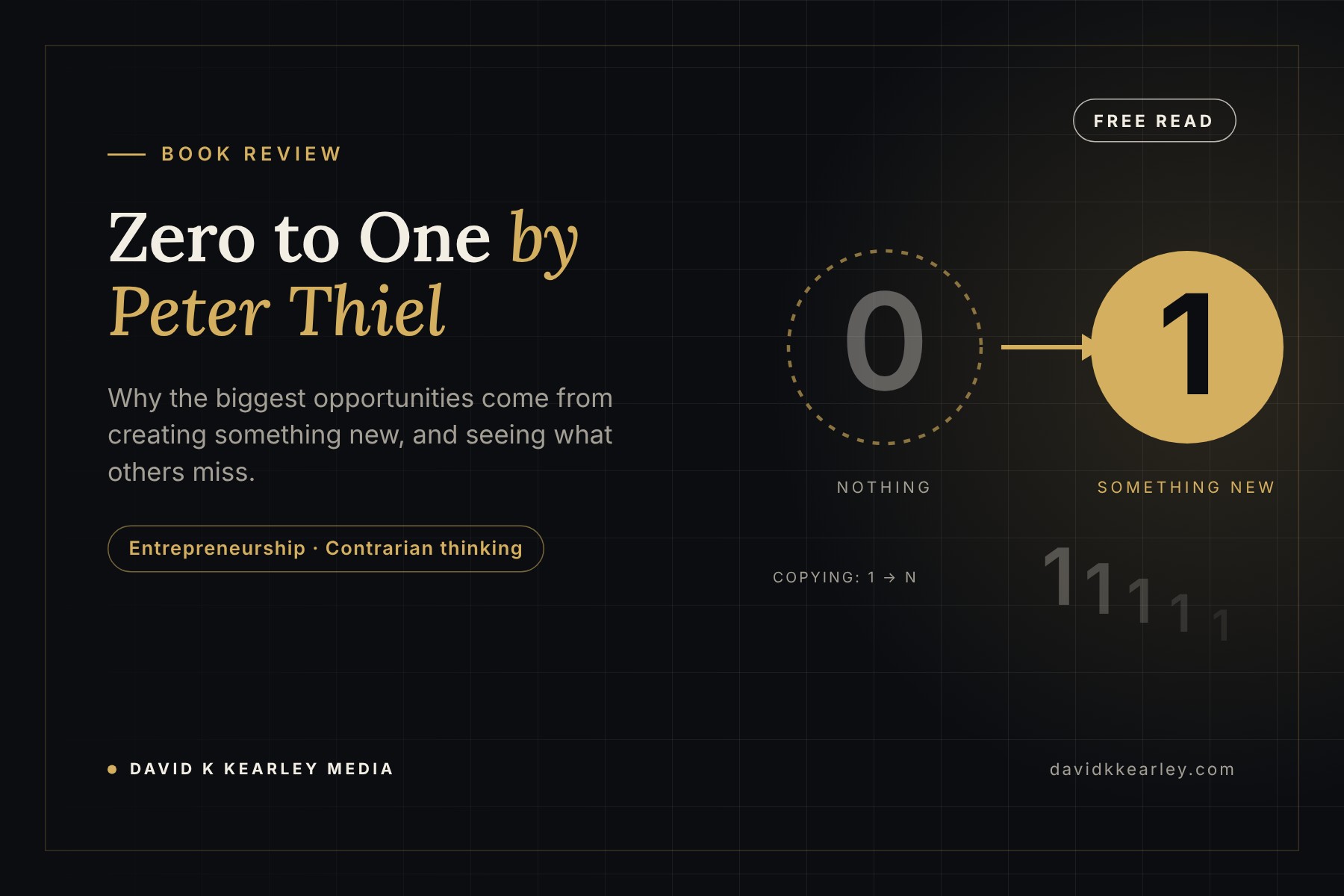
Thiel, the co-founder of PayPal and an early investor in Facebook, challenges conventional wisdom throughout the book. His central argument is that genuine progress comes not from copying what already exists, but from creating something entirely new. Going from zero to one means bringing something original into existence, whereas going from one to many simply means replicating an existing idea.
What I particularly enjoyed was the contrarian nature of his thinking. Thiel encourages readers to question the status quo, challenge widely accepted assumptions and search for important truths that others have overlooked.
Competition Is for Losers
One of the book’s most provocative arguments is that competition is often destructive, while monopolies created through genuine innovation can be enormously valuable.
This immediately brings to mind the Magnificent Seven technology companies: Microsoft, Apple, Alphabet, Amazon, Meta, Nvidia and Tesla. Each has established a powerful position in its respective industry, although not all are monopolies in the strict economic sense. Their success demonstrates the extraordinary value of network effects, economies of scale, proprietary technology and competitive advantages that are difficult to replicate.
These businesses have created ecosystems that competitors struggle to displace. Rather than simply competing within existing markets, many helped define the markets in which they operate.
From an investment perspective, this is an important distinction. A company with a defensible market position can capture a disproportionate share of the economic rewards created by an expanding industry.
Rethinking Risk
Perhaps the most lasting influence the book has had on me is how it changed my perception of risk.
Consider Meta. In a world increasingly connected by the internet, the emergence of large social networks was arguably inevitable. Once a dominant network established itself, every additional user increased its value to everyone else, creating a powerful advantage over smaller competitors.
From this perspective, the emergence of a dominant social network was not necessarily a speculative technological experiment. It was an economic opportunity whose time had come.
Of course, identifying the eventual winner was another matter entirely. The inevitability of an industry does not guarantee the success of any individual company. Nevertheless, understanding the structural forces behind an emerging market can change how we assess its risks.
This distinction has become increasingly important to my investment philosophy.
Discovering Truth Before the Market
Thiel famously asks readers to consider what important truth very few people agree with them on. I find this question particularly relevant to investing.
Take Coinbase, for example. The company is still widely viewed through the lens of cryptocurrency trading, with its valuation heavily influenced by the cyclical nature of crypto markets.
My view is that Coinbase is gradually transforming into something considerably more important: a financial infrastructure company supporting stablecoins, payments, smart contracts and the tokenisation of financial assets.
If this transformation succeeds, its business model could become more diversified, with recurring revenue streams that reduce its dependence on speculative trading activity.
The opportunity, as I see it, lies in recognising a potential change in the company’s underlying risk profile before that change is fully appreciated by the broader market.
This is increasingly what I look for as an investor: businesses undergoing structural transformations that may not yet be reflected in their valuations. I try to identify these changes, develop conviction through research, and then patiently wait for the market to recognise what I believe to be true.
Naturally, the market may never agree, and a thesis must continually be tested against new evidence. But the willingness to think independently is where the process begins.
Final Thoughts
Zero to One is a relatively short, accessible book, but its ideas are anything but ordinary. It challenges readers to think differently about competition, innovation, entrepreneurship and the future.
I read it a decade ago, and I can confidently say it helped shape the way I approach business and investing today. That evolution has involved many other books, experiences, mistakes and lessons along the way. No single book can provide a complete framework for understanding the world.
Nevertheless, Zero to One was an important part of that journey.
Its greatest lesson, for me, is not that being contrarian automatically makes you right. It is that independent thinking is essential if you hope to recognise opportunities that others have yet to appreciate.
The greatest opportunities often begin with seeing the world differently, and having the patience to discover whether your convictions are correct.


Leave a Reply