Bullish: Investing in the Future of Global Financial Exchanges
27 October 2026 | Equity Research | NYSE: BLSH
The Investment Thesis
Financial markets are approaching what could become one of their most significant technological transformations in decades. Traditional stock exchanges have dominated global capital markets for generations, but blockchain technology is introducing an alternative infrastructure for trading, settlement and asset ownership.
At the centre of this emerging opportunity is Bullish (NYSE: BLSH), a company I believe is particularly well positioned to benefit from the modernisation of global financial markets.
My investment thesis rests on a relatively straightforward proposition: financial assets will increasingly migrate onto blockchain-based infrastructure, and the companies facilitating that transition could become enormously valuable.
Bullish offers exposure to this transformation through its institutional cryptocurrency exchange, financial information services and developing tokenised securities strategy.
What particularly interests me is the possibility that blockchain technology could eventually reduce the dependence of global capital markets on fragmented legacy infrastructure.
The opportunity extends considerably beyond cryptocurrency trading.
A New Generation of Financial Infrastructure
Bullish operates a regulated, institutionally focused cryptocurrency exchange designed to combine the liquidity and reliability of traditional financial markets with the technological advantages of digital assets.
Its trading architecture combines a central limit order book with automated market-making capabilities. This allows Bullish to provide liquidity while maintaining the familiar execution mechanisms institutional investors expect.
The distinction between centralised trading and blockchain-based settlement is particularly important.
In my earlier research into Bullish, I explored how specialised exchange infrastructure could combine the speed of traditional centralised exchanges with the transparency and settlement capabilities associated with blockchain technology.
Institutional investors require extremely fast execution, deep liquidity and sophisticated risk management. Public blockchains, particularly Ethereum, offer different advantages, including programmability, tokenisation and decentralised financial applications.
These technologies need not be mutually exclusive.
A plausible future financial system could use specialised trading infrastructure for transaction execution while employing blockchain networks for asset ownership, transfer and settlement.
Bullish’s hybrid exchange model reflects aspects of this broader technological convergence.
For further information on the company’s institutional trading infrastructure, see Bullish’s official exchange platform.
Financial Performance: Growth Beneath the Volatility
Bullish’s second-quarter 2026 results demonstrate both the potential and the challenges of its business model.
| Financial metric | Q2 2025 | Q2 2026 | Change |
|---|---|---|---|
| Digital asset sales | $58.6B | $32.6B | -44% |
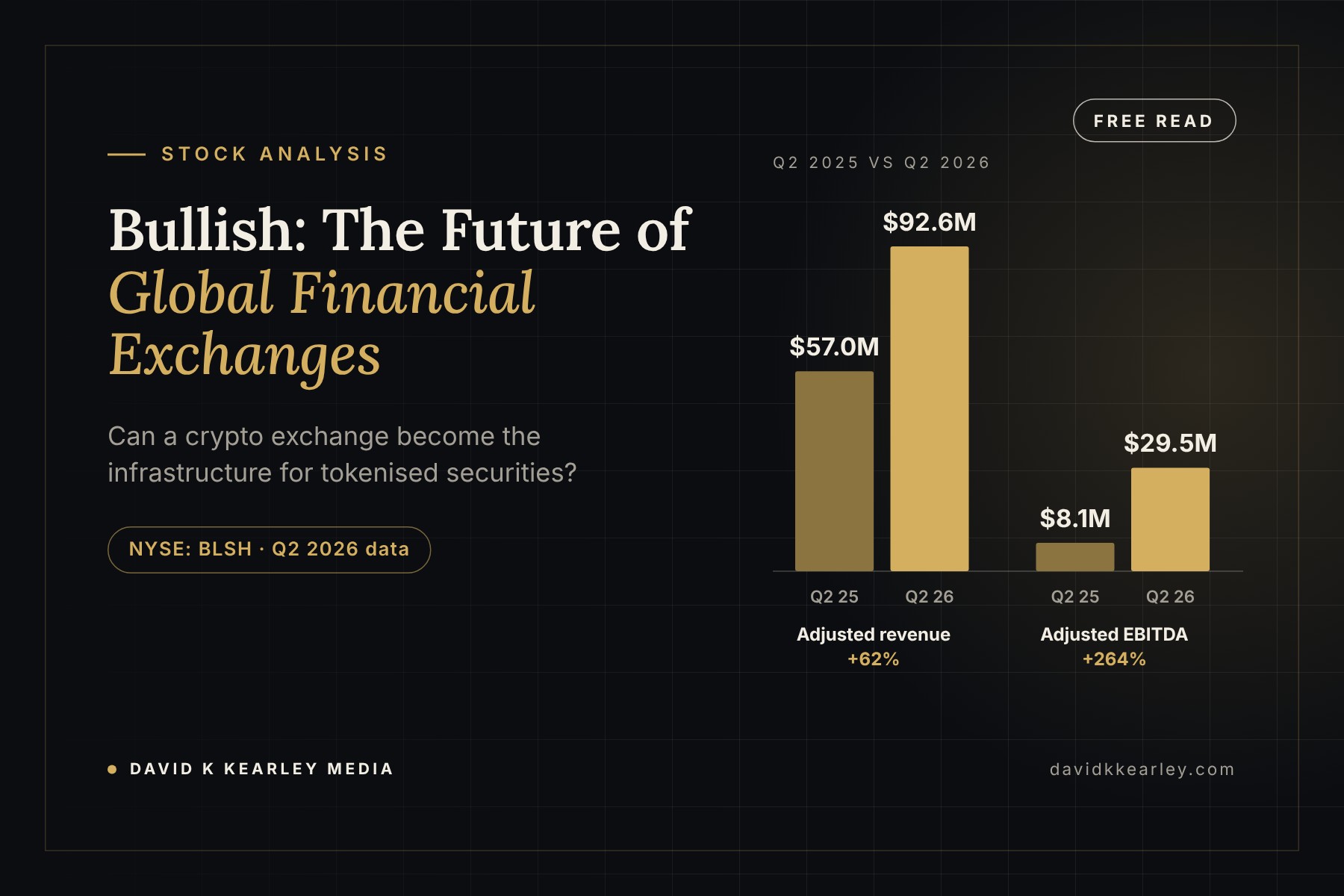
| Adjusted revenue | $57.0M | $92.6M | +62% |
| Adjusted transaction revenue | $24.1M | $29.9M | +24% |
| Adjusted EBITDA | $8.1M | $29.5M | +264% |
| Net income/(loss) | $108.3M | -$280.0M | Negative swing |
Source: Bullish — Q2 2026 Financial Results. Adjusted figures are non-IFRS measures.
Despite declining digital asset sales, adjusted revenue increased substantially, while adjusted EBITDA more than tripled.
This suggests that Bullish is becoming less dependent on the volume of digital assets changing hands and increasingly benefiting from its diversified revenue streams.
However, the substantial reported net loss cannot be ignored. Fair-value movements in digital asset holdings contributed significantly to earnings volatility.
For investors, the distinction between underlying operating performance and reported profitability is particularly important.
Bullish’s financial statements require careful interpretation because the accounting treatment of digital asset transactions can produce very large reported sales figures relative to the economic revenue generated.
The more useful measures for evaluating the underlying business include adjusted revenue, transaction revenue, recurring services revenue, cash generation and operating profitability.
Trading Volumes and Institutional Adoption
Bullish continues to facilitate substantial trading activity across its exchange.
Its reported total trading volume reached approximately $48.6 billion in September 2026, compared with $39.6 billion in September 2025.
This represents year-on-year growth of approximately 23%.
These figures demonstrate the considerable scale of trading already occurring through the platform.
Nevertheless, monthly trading volumes remain volatile, reflecting changing cryptocurrency market conditions.
Bullish’s long-term opportunity depends on expanding institutional participation, increasing its market share and developing additional products capable of generating recurring revenue.
The company’s competitive position will ultimately be determined not simply by how much trading occurs on its platform, but by how efficiently it can monetise that activity.
Source: Bullish — September 2026 Trading Metrics.
The Opportunity to Replace Legacy Exchanges
Traditional securities markets rely on a complex network of exchanges, brokers, custodians, clearinghouses and settlement institutions.
Although these systems are reliable, they introduce operational complexity and costs.
In the United States, most equity transactions settle one business day after execution under the T+1 settlement framework.
Blockchain-based infrastructure could eventually allow tokenised equities, bonds and other financial assets to trade continuously, with ownership transfers and settlement occurring more efficiently.
Consider a future in which investors can purchase tokenised securities across international markets without navigating the same fragmented settlement architecture that exists today.
This is where Bullish’s long-term opportunity becomes particularly interesting.
The Equiniti Acquisition
In May 2026, Bullish announced its proposed $4.2 billion acquisition of Equiniti, a major provider of shareholder services and transfer agency infrastructure.
If completed, the acquisition could give Bullish capabilities spanning securities issuance, shareholder registration, trading and ownership records.
The transaction is expected to close in January 2027, subject to regulatory approvals and customary conditions.
This represents a potentially significant strategic development.
Bullish would no longer be positioned solely as a cryptocurrency exchange. It could become a broader financial infrastructure provider capable of supporting the lifecycle of tokenised securities.
On 26 October 2026, Bullish and Equiniti announced further participation in their Issuer Sponsored Token Coalition, including Qube Research & Technologies, Vertalo and zerohash.
These developments suggest that the company is actively pursuing the infrastructure required to connect traditional securities markets with blockchain-based financial systems.
Source: Bullish — Issuer Sponsored Token Coalition Announcement, October 2026.
Importantly, replacing traditional exchanges is not inevitable. Existing exchanges can adopt blockchain technology themselves, and established clearing and custody institutions may remain essential.
Nevertheless, Bullish is positioning itself to participate directly in this transformation.
Competitive Positioning
Bullish operates in an increasingly competitive industry.
| Company | Primary business | Competitive advantage |
|---|---|---|
| Bullish | Institutional digital asset exchange and infrastructure | Institutional liquidity, tokenisation strategy and CoinDesk |
| Coinbase | Cryptocurrency exchange and financial services | Distribution, brand recognition and broad product ecosystem |
| Nasdaq | Securities exchanges and financial technology | Established market infrastructure and institutional relationships |
| Intercontinental Exchange | Exchanges, clearing and financial data | Scale, regulatory infrastructure and diversified revenues |
Coinbase represents a particularly important competitor.
In Q2 2026, Coinbase reported cryptocurrency trading volume market share of approximately 10.3%, demonstrating the strength of its established platform.
Source: Coinbase — Q2 2026 Earnings.
Meanwhile, traditional exchange operators possess substantial competitive advantages through regulation, liquidity networks, customer relationships and existing market infrastructure.
Intercontinental Exchange, which owns the New York Stock Exchange, generated approximately $2.7 billion in net revenue during Q2 2026.
Bullish remains considerably smaller than these established financial institutions.
However, smaller companies can sometimes benefit disproportionately when technological changes create opportunities to challenge existing business models.
I believe Bullish’s opportunity lies in becoming a credible institutional alternative as financial markets increasingly adopt blockchain-enabled infrastructure.
Valuation: What Is the Market Pricing In?
Bullish’s equity valuation stood at approximately $4.2 billion during trading on 26 October 2026.
Using reported trailing adjusted revenue of approximately $301 million as a reference point, this implies a market-capitalisation-to-adjusted-revenue multiple of roughly 14 times.
That is not an obviously inexpensive valuation for a company reporting substantial accounting losses.
However, conventional valuation multiples may not fully capture the optionality associated with Bullish’s tokenisation strategy.
The investment case therefore depends heavily on future growth.
If Bullish successfully expands its institutional trading business, increases recurring revenue and develops meaningful tokenised securities operations, its earnings potential could look substantially different several years from now.
Conversely, if institutional adoption disappoints or competitive pressures compress trading margins, today’s valuation could prove demanding.
Investors should also consider the financing, integration and potential dilution implications of the proposed Equiniti acquisition.
Valuation reference: Bullish — Market Capitalisation and Financial Statistics.
The Risks
There are several important risks to this thesis.
Regulatory uncertainty: Tokenised securities must satisfy complex securities laws, shareholder rights requirements and jurisdiction-specific regulations.
Competition: Coinbase, traditional exchanges and emerging blockchain platforms are all pursuing similar opportunities.
Profitability: Bullish must demonstrate that revenue growth can translate into sustainable cash generation and shareholder returns.
Execution: The Equiniti acquisition introduces integration, financing and regulatory risks.
Market volatility: Cryptocurrency trading activity remains sensitive to asset prices, investor sentiment and broader financial conditions.
These risks are substantial and should be considered alongside the company’s long-term potential.
Conclusion: Investing in the Infrastructure of Tomorrow
My bullish outlook on Bullish is ultimately based on a broader conviction about the direction of global finance.
I believe financial markets will become increasingly digital, programmable and interconnected. Blockchain technology offers the potential to improve settlement efficiency, broaden market access and reduce operational complexity.
What makes Bullish particularly interesting is its attempt to combine the strengths of traditional financial market infrastructure with the technological advantages of blockchain.
Its institutional exchange provides an established operating business, CoinDesk adds data and information services, and the proposed Equiniti acquisition could create a meaningful position in tokenised securities infrastructure.
The company is not yet a replacement for traditional stock exchanges, and its financial performance remains volatile.
Nevertheless, I believe the greatest opportunity in cryptocurrency may not be the currencies themselves, but the financial infrastructure being built around them.
Bullish offers investors exposure to that possibility.
The investment thesis is therefore not simply that cryptocurrency trading will grow. It is that the infrastructure supporting global financial markets could undergo a fundamental transformation—and Bullish may emerge as one of the companies helping to shape it.
Investment disclosure: This article presents a bullish investment thesis for educational and research purposes. It is not personalised financial advice. Cryptocurrency-related equities are volatile and can experience substantial permanent capital losses. Financial data is based on the latest verified quarterly results available for this analysis, Q2 2026, rather than an unverified October 2026 share-price snapshot.





Leave a Reply